
Managed VPS vs Unmanaged VPS Hosting: Which One Should You Choose?
The decision between Managed VPS and Unmanaged VPS hosting is one of the most critical choices any website owner has to make. Compared to traditional shared hosting, both options provide significantly more server power, dedicated resources, and control. However, the fundamental difference lies in who handles the technical server management.
For beginners and busy site owners, managed VPS hosting simplifies operations by delegating technical responsibilities to the hosting provider. On the other hand, unmanaged VPS hosting gives you total administrative control at a lower cost, but it demands technical expertise to configure, secure, and maintain the server.
This comprehensive guide compares managed VPS vs unmanaged VPS hosting, detailing their key differences, advantages, disadvantages, security levels, performance, and pricing to help you choose the ideal hosting solution for your website.
Managed VPS vs Unmanaged VPS Hosting What Is VPS Hosting?
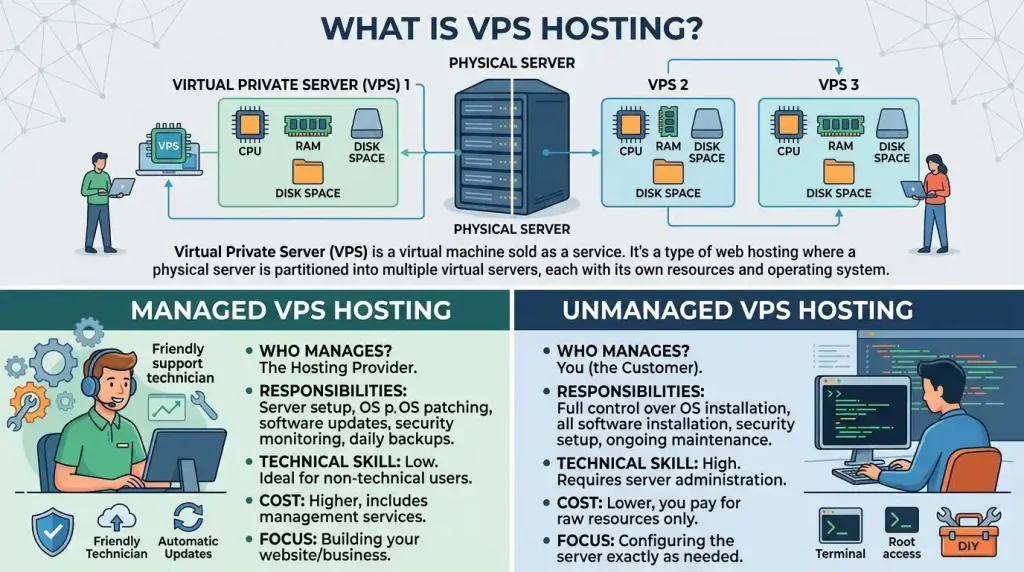
VPS (Virtual Private Server) hosting is a web hosting environment where a physical server is divided into multiple isolated virtual servers. Each VPS operates independently with dedicated resources, including assigned CPU cores, RAM, SSD storage, and an isolated operating system (OS).
Unlike shared hosting—where hundreds of websites share the same pool of server resources—VPS hosting delivers a dedicated virtual space. This architecture drastically improves website loading speed, security, overall performance, and server stability.
VPS hosting is widely popular among fast-growing blogs, business platforms, eCommerce stores, WordPress sites, digital agencies, and developers who have outgrown standard shared hosting plans.
What Is Managed VPS Hosting?
Managed VPS hosting is a hands-off hosting solution where the hosting provider manages the technical infrastructure of your virtual server.
The web host handles server setup, operating system updates, security patches, routine backups, performance monitoring, and technical troubleshooting. Because the host maintains the backend, you can focus entirely on growing your business, creating content, and serving your audience.
- Ideal for: Beginners, small business owners, bloggers, agencies, and WordPress users who prefer high performance without backend technical stress.
What Is Unmanaged VPS Hosting?
Unmanaged VPS hosting (also known as self-managed VPS) provides you with raw virtual server resources while leaving all administrative tasks in your hands. The hosting company is strictly responsible for maintaining physical hardware health and network uptime.
With an unmanaged VPS, you are responsible for installing the operating system, configuring web servers (Apache and Nginx), setting up firewalls, managing databases, running regular backups, and resolving technical glitches independently.
- Ideal for: System administrators, web developers, tech-savvy users, and businesses with dedicated IT personnel who require maximum server customisation.
Main Differences Between Managed and Unmanaged VPS
The primary distinction between managed and unmanaged VPS hosting boils down to responsibility. With managed hosting, the host maintains the server environment; with unmanaged hosting, you take full responsibility.
Managed VPS vs Unmanaged VPS Comparison
| Feature | Managed VPS Hosting | Unmanaged VPS Hosting |
|---|---|---|
| Server Management | Fully managed by the host | Fully managed by the user |
| User Experience | Beginner-friendly | Requires advanced technical skills |
| Technical Support | 24/7 comprehensive support | Hardware and network support only |
| Security & Updates | Automated patches and firewall rules handled by host | User must manually apply patches and firewall rules |
| Root Access & Control | Standard root access (may have security restrictions) | Complete, unrestricted root control |
| Pricing | Higher overall monthly cost | Budget-friendly / Low cost |
| Best Suitable For | Non-technical users, stores, and businesses | Developers, sysadmins, and tech-savvy users |
Advantages of Managed VPS Hosting
Managed VPS hosting offers numerous operational benefits for users who need a powerful hosting setup without the technical overhead.
1. Easy Server Management
The single biggest advantage is convenience. You don’t need terminal knowledge or server administration expertise. Setting up control panels, configuring web servers, and fixing system errors are handled by experts.
2. Comprehensive Technical Support
Managed VPS plans include dedicated 24/7 technical support. If your website experiences downtime, configuration issues, or server errors, expert sysadmins are available to resolve them quickly.
3. Enhanced Server Security
Security is handled proactively. Most providers include automated server monitoring, firewall management, malware scanning, OS patching, and regular vulnerability checks to keep your environment secure.
4. Saves Valuable Time
Managing a server manually demands hours of maintenance every week. Managed VPS hosting frees up your schedule so you can focus on marketing, sales, and business operations.
5. Perfect for WordPress Sites
WordPress sites require continuous performance optimisation, database maintenance, and security updates. Managed VPS hosts often optimise their server stacks (using LiteSpeed, Nginx, or Redis caching) specifically for WordPress acceleration.
Disadvantages of Managed VPS Hosting
Despite its convenience, managed VPS hosting has a few drawbacks to consider:
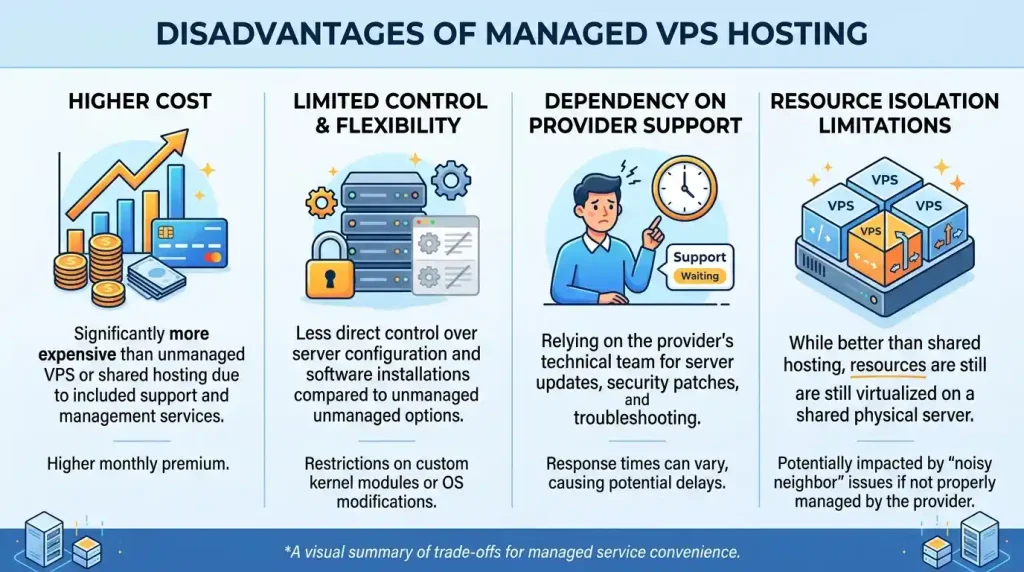
- Higher Price Tag: You are paying for both server hardware and human expertise, making it more expensive than unmanaged alternatives.
- Slightly Restricted Control: Hosting providers may restrict certain deep system-level tweaks or custom software installations to safeguard overall server stability.
- Dependent on Host Quality: Server management quality varies between providers. It is important to choose a reputable host with proven support reliability.
Advantages of Unmanaged VPS Hosting
For experienced users and developers, unmanaged VPS hosting delivers complete technical freedom and unbeatable cost efficiency.
1. Budget-Friendly Pricing
Since the host doesn’t allocate system admin resources to your account, unmanaged VPS plans are significantly cheaper, making them ideal for budget-conscious developers.
2. Complete Root Access & Server Control
You receive full root access to your server. You can choose any Linux distribution, build custom server stacks, configure unique ports, and tweak system kernel parameters without restrictions.
3. Infinite Customization
Whether you need specific database engines, custom caching frameworks, or specialised programming environments (like Node.js, Python, or Rust), an unmanaged VPS gives you full authority to configure everything.
4. Great Learning Environment
An unmanaged server serves as an excellent sandbox to practise Linux administration, command-line usage (Bash), SSH key management, Nginx configurations, and cybersecurity practices.
Disadvantages of Unmanaged VPS Hosting
Unmanaged hosting presents significant risks for non-technical users:
- Requires Deep Technical Knowledge: You must be proficient in SSH commands, server OS installation, command-line operations, and networking concepts.
- Minimal Support: If your web server crashes, a database corrupts, or a bad script breaks your environment, the host’s support team will not fix it for you.
- Higher Security Exposure: Misconfigured firewalls or outdated server software can leave your server vulnerable to cyberattacks, brute-force exploits, and malware infections.
- Time-Consuming Maintenance: Monitoring uptime, managing manual backups, applying patches, and troubleshooting bugs requires ongoing effort.
Security, Performance, and Support Comparison
Security Comparison
- Managed VPS: Highly secure out-of-the-box. Providers implement automated firewalls, DDoS protection, regular patch cycles, and server monitoring.
- Unmanaged VPS: Security relies entirely on your skills. If you fail to configure fail2ban, secure open ports, or update packages, your server is vulnerable.
Performance Comparison
- Managed VPS: Pre-optimised by experts for maximum speed and caching efficiency right out of the box.
- Unmanaged VPS: Can achieve equal or superior performance, provided you know how to properly tune server parameters and caching engines yourself.
Support Comparison
- Managed VPS: Includes full application-level and server-level support to resolve technical issues promptly.
- Unmanaged VPS: Support is restricted to physical infrastructure, hardware failures, and core network connectivity.
Who Should Choose Managed VPS Hosting?
Managed VPS hosting is the recommended path for:
- Small and medium-sized business websites
- Rapidly growing bloggers and content creators
- eCommerce stores (WooCommerce, Magento, Shopify alternative setups)
- Agencies hosting client websites
- Non-technical users who value peace of mind and time savings

Who Should Choose Unmanaged VPS Hosting?
Unmanaged VPS hosting is the ideal choice for:
- Web developers and software engineers
- Linux system administrators
- Tech startups building custom web applications
- Users running staging/testing sandbox environments
- Budget-focused technical experts
Which VPS Hosting Is Best for Your Needs?
Best for Beginners: Managed VPS
Beginners should opt for Managed VPS hosting. Managing server security, firewall rules, and updates through command-line interfaces without prior experience can lead to costly downtime and data loss.
Best for WordPress: Managed VPS
For WordPress deployment, a managed VPS is recommended. The automated server optimisations, server-side caching mechanisms, and managed updates keep WordPress sites fast and secure effortlessly.
Best for Developers: Unmanaged VPS
For application developers, an unmanaged VPS is the superior tool. It offers complete freedom to deploy custom development environments, containers (Docker), and customised server frameworks at a fraction of the cost.
Final Verdict
The choice between managed VPS and unmanaged VPS hosting ultimately comes down to your technical capability, budget, and free time:
- Choose Managed VPS Hosting if you want high server performance, solid security, and dedicated support without the head-splitting task of server maintenance. It costs more but saves time and prevents technical errors.
- Choose Unmanaged VPS Hosting if you possess server administration skills, demand full administrative control over your OS environment, and want to keep hosting costs as low as possible.
Frequently Asked Questions (FAQs)
What is the main difference between managed and unmanaged VPS?
The main difference is server management. Managed VPS hosting includes technical backend maintenance provided by the hosting host, whereas unmanaged VPS hosting requires you to manage setup, security, updates, and maintenance yourself.
Is an unmanaged VPS cheaper than a managed VPS?
Yes, unmanaged VPS plans are significantly cheaper because you aren’t paying for system administration or dedicated technical support services.
Do I need command-line skills for a managed VPS?
No, managed VPS hosting does not require command-line knowledge. Most plans include user-friendly control panels like cPanel, Plesk, or custom dashboards.
Can I host WordPress on an unmanaged VPS?
Yes, you can run WordPress on an unmanaged VPS, but you will need to manually install the web server (Apache/Nginx), PHP, and MySQL/MariaDB database and configure security rules yourself.
Which VPS option is safer for business websites?
Managed VPS is generally safer for commercial sites because experienced sysadmins manage server security, perform regular updates, and apply security patches immediately.