
How to Choose the Best Cloud Hosting for Your Website (Beginner’s Guide)
When you are going to start a website, it gets very confusing to select the best cloud hosting. There are more hosts, more price options and an abundance of jargon that obfuscate making the decision harder than it has to be.
However, there is nothing more crucial for any site than the decision of hosting.
An excellent hosting service, on the other hand, will get your website up and running fast while keeping it online when traffic surges and your data safe while you scale longer term. Conversely, weak hosting can lead to a sluggish site, expose it to vulnerabilities, and ruin the end-user experience.
This is why the selection of the best cloud hosting is not merely budget-oriented. It is all about speed, security, scalability, reliability and support — and how seamlessly the host meshes with your goals for your website!
In this tutorial you will learn what is cloud hosting, the way it works, advantages of cloud hosting, disadvantages of cloud hosting and how to use a best Cloud Hosting on your site
What Is Cloud Hosting?
The best cloud hosting plans deploy your website to a number of connected servers, rather than relying on just one physical server (as with other types of web hosting).
You would want to finalise your regular host, as a website traditionally relies on a single server. Your website may also itself get slow or not accessible if that server is slow or is having some issue.
Cloud hosting works differently.
It uses multiple servers together. Such servers have access to shared resources like CPU, RAM, storage, and bandwidth. Cloud hosting allows for easy scalability of resources when your site requires more power than what basic shared hosting can offer.
Cloud hosting is beneficial for sites that require high availability in terms of performance and resources, as well as reliability.
If you suddenly receive more traffic to your website due to a campaign, sale or post going viral, cloud hosting is designed to handle the increased volumes in a way that many standard hosting plans cannot.

How Does Cloud Hosting Work?
Cloud hosting utilises virtualisation technology along with a cluster of servers in the backend. In contrast to hosting your website on one single server, cloud hosting distributes the resources over a cloud infrastructure.
When people visit your website, the cloud system provides required files, database information and resources through an open-available servernet.
This setup can lessen downtime as your website is not entirely reliant on a single machine. Whenever there is an issue with one of the servers, there will be some other server in the network which will help you to continue the service.
So in general, a cloud hosting environment might consist of:
Cloud servers
Storage resources
CPU and RAM allocation
Load balancing
Security systems
Backup options
Monitoring tools
Resource scaling features
Server management dashboard
So, the primary reason is this: cloud hosting provides your website with the ability to easily scale its resources to handle additional traffic as your business grows.
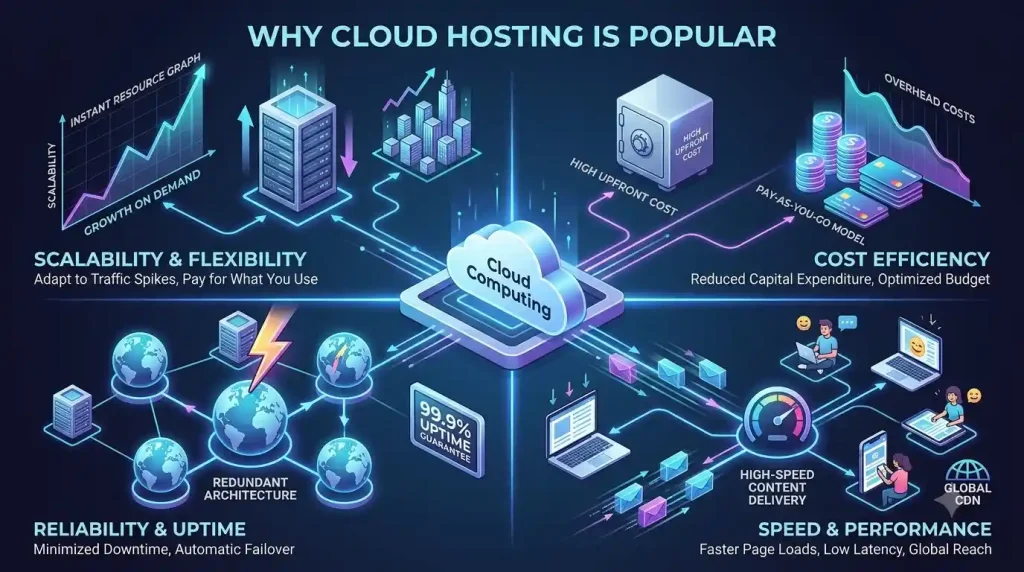
Why Cloud Hosting Is Popular
You will find that cloud hosting is very popular, as websites nowadays are in dire need of speed, stability and flexibility. For non-retailers, slow or tar-like hosting is an unacceptable reality in 2023.
Users expect web pages to load promptly. Even search engines are concerned about the experience of the visitor. A slow website means visitors may not wait to read the content or purchase a product.
Many of these issues are solved through cloud hosting.
It can also cope with increasing traffic loads, offer higher uptime, and allow owners to have more control over resources. That is why the cloud is hosting used with blogs, business sites, eCommerce stores, agencies, SaaS companies and high-traffic platforms.
The best cloud hosting is usually the one that gives a good balance against performance, security, support and pricing.
What Should You Look For In The Best Cloud Hosting?
When selecting any cloud hosting provider, it is critical to know which features are most important for you. A cheap plan is not a good plan! Not every popular provider is the right fit for your website.
Cloud hosting should deliver the resources you really need to run your site.
Speed and Performance
The speed at which your website loads is mainly why you choose cloud hosting. A speedy website results in an excellent user experience and a lower bounce rate, with visitors staying engaged.
The right cloud hosting must come with high-performance servers, a fast storage layer, optimised resources, and network speed to be recognised.
Keep an eye out for features like SSD or NVMe storage, current server technology specs, caching support, CDN integration options and excellent uptime performances.
Even more so if your website runs on WordPress, as speed becomes all the more crucial. Too many plugins, bulky images, and bad hosting can make your site slow as a turtle.
The ideal cloud hosting should provide your site with enough resources so it loads seamlessly.
Security Features
Cloud hosting comes with another aspect of security. From the comments made by the users of your website to details about customers logging in, making payments and private files related to your business that lie on this structure somewhere.
The best cloud hosting providers include decent software or hardware security features like SSL support, firewalls, DDoS protection, malware scanning, account isolation and regular back-end updates in their plans to stay ahead of new types of cyber threats.
Hosting alone is never enough, and this thought process of cloud hosting comes with strong security. On top of that, you should also use great passwords, make sure to update the software of your website, eliminate dangerous plugins and perform regular backups.
The ideal cloud hosting should simplify security, not complicate it.
Scalability
Scalability simply means that your hosting can scale up as your website grows.
It’s another of the prime reasons as to why people opt for cloud hosting. When your site gets higher traffic, you probably need higher CPU, RAM storage or bandwidth. Cloud hosting can oftentimes scale resources without relocating your entire site to an entirely new server.
Great for online shops, corporate websites, new sites, easy membership sites and marketing campaigns/blogs in spite of the fact.
For instance, an eCommerce website may receive increased traffic during Black Friday, Christmas or a specific discount campaign. Cloud hosting helps the website to cope with that traffic more seamlessly.
The right cloud hosting should ensure that you can upgrade resources with ease.
Customer Support
For laymen, good support is critical.
Cloud hosting can be a little technical sometimes. You might need help with migration, SSL installation, server errors, backup restoration, speed optimisation or WordPress from time to time.
Fast and helpful support is a sign of a good hosting provider. Having live chat, ticket support, email support and knowledge base articles can make a huge difference.
Verify if support will be at your disposal 24/7 and that the support understands the platform of your website before buying hosting.
Managed cloud hosting is usually more suitable for the novice user since there are many technical processes taken care of by the service provider.
Backup and Recovery
And back up data loss protection for your website. When your website crashes, gets hacked or has some technical problem, backup will restore everything.
Ideal cloud hosting should come with automatic backups and restoration options.
A good way to do this is check how frequent backups run. However, it is more suitable to perform a daily backup if the website is being frequently updated. For simple websites it may be okay to do backups only once a week, but for frequent updating that is not the best option.
If you are using WordPress or running an online store or business website, backup and recovery features become exceptionally critical.
Pricing
Cloud hosting may cost quite a bit in price. While some providers have monthly fixed fees, others charge monthly on the basis of usage.
A low price might seem appealing, but be sure to check what it includes. Some hosting plans may seem affordable at first glance but then charge additional for backups, security, email hosting, migration, CDN or support.
Cloud hosting worth of your money When talking about the answer to the best cloud hosting, one must include clear pricing and good value for money.
Avoid selecting hosting because it is inexpensive. The choice of hosting should be based on speed and reliability, along with support and security to match your website requirements.
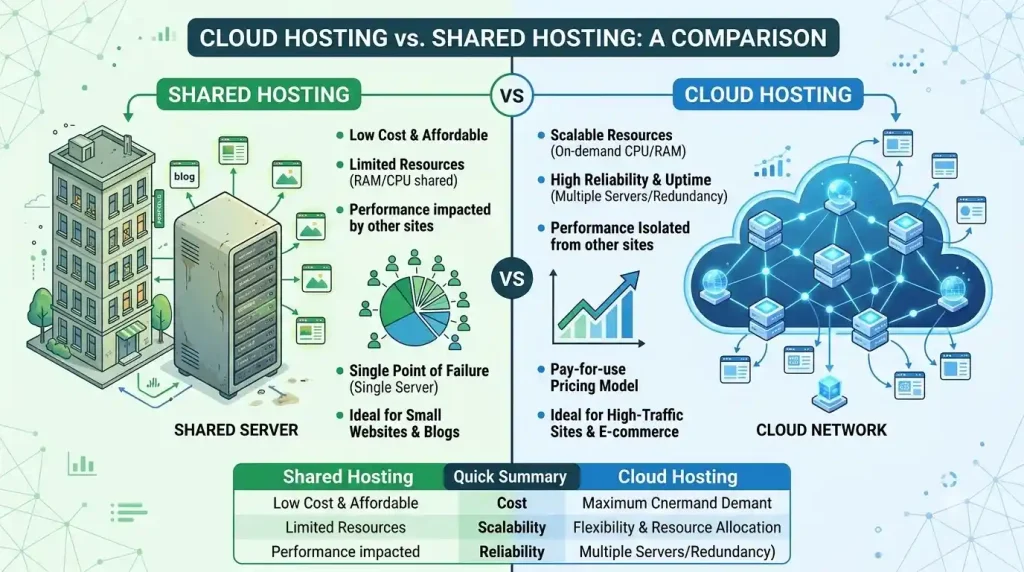
Cloud Hosting vs Shared Hosting
Shared hosting is the simplest form of web hosting. That means traditionally inexpensive and easy to get started. Multiple websites are running on the same server resource in shared hosting.
This works fine for small websites, blogs, and low-traffic startups.
However, shared hosting has limits. If another site on that server is monopolising too many resources, your site can slow down. Your access to some server settings is also limited.
Cloud hosting is more flexible.
Whereas in cloud hosting there is high availability because it uses a cluster of servers rather than just one shared server. This can provide increased performance, uptime and scalability.
Shared hosting is a good option for amateur hosts on low budgets Where cloud hosting is better: Cloud hosting is better for larger-sized growing websites, business websites and websites that are looking for stronger performance.
Cloud Hosting vs VPS Hosting
With VPS hosting, you are provided with a dedicated virtual server. It provides greater control than shared hosting and is often used by websites that require dedicated resources.
The cloud is also more flexible than VPS hosting, as it is much easier for cloud resources to scale. A VPS host typically relies on a single physical server, while a cloud host can use multiple servers linked together.
VPS hosting caters to resource-conscious users who want control over their server environment. Cloud hosting is more suited to users requiring flexibility, scalability and superior uptime support.
Which is the perfect choice for you? Well, it completely depends on your website size, traffic, technical experience and, of course, budget.
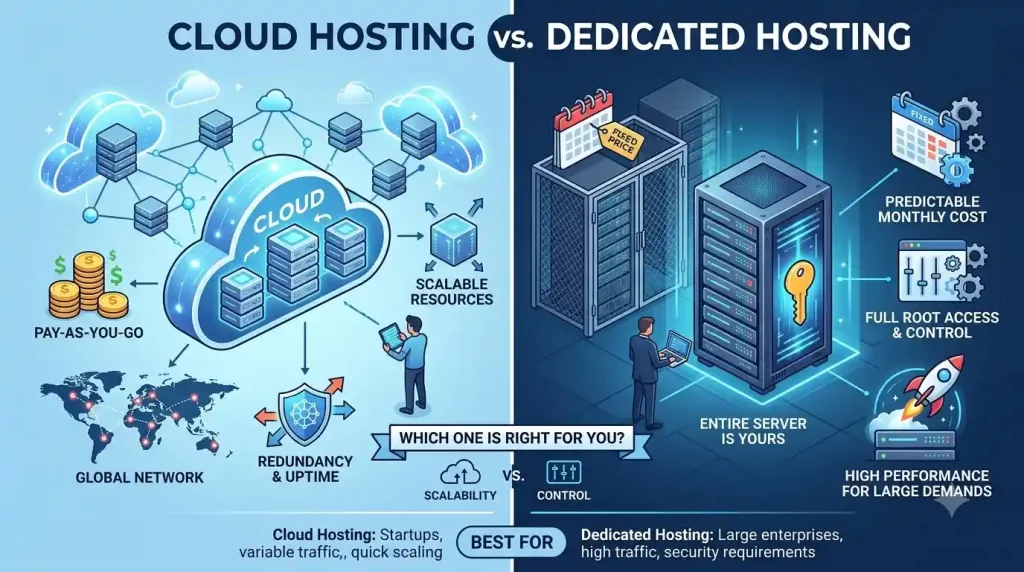
Cloud Hosting vs Dedicated Hosting
Dedicated Hosting: You get an entire physical server for your website/application. It has solid control over the performance but comes at a higher cost.
Cloud Hosting: Cloud computing provides adaptable assets through a cloud infrastructure. And it can be easier to scale – and more budget-friendly – for lots of outgrowing websites.
We hope dedicated hosting is a good fit for large enterprises, custom apps or sites that require total server control. Cloud hosting serves sites that need the flexibility, reliability, and scaling up of resources with ease.
Because of this, cloud hosting is a better mid-range option that will suit many types of website owners perfectly between VPS and dedicated hosting.
Who Should Use Cloud Hosting?
Cloud hosting is the best choice for most sites. If your website requires improved speeds, increased uptime, or just a room to grow, you should consider cloud hosting.
Now, expecting cloud-based hosting can be the best pick if:
Business websites
WordPress websites
eCommerce stores
Agency websites
SaaS platforms
Membership websites
Online learning websites
News websites
High-traffic blogs
Web applications
Portfolio websites with growing traffic
But cloud hosting won’t be a must-have for every site.
Here is what you need to know in order to choose the right one for you. If it is your first small personal blog or a basic single-page website, then maybe shared hosting would be sufficient for the start. However, if your website is valuable for business, sales, leads or customer experience, it would be more reasonable to go with cloud hosting.
Cloud Hosting: Is it Good for WordPress?
And the answer is yes, cloud hosting can be pretty good for WordPress sites.
WordPress, which is based on the LAMP stack, requires good speed, stable performance and strong security from its websites. If your WordPress site has lots of plugins, a large image, WooCommerce pages, membership features or LMS tools, then basic hosting can become slow quite quickly.
Cloud hosting allows hosting providers to offer more resources and greater flexibility for WordPress websites.
This also enables the ability to support advanced caching, staging sites, backups and server-level optimisation and traffic scaling.
However, good hosting cannot solve each and every WP performance problem. But you need to be optimising images, having a lightweight theme, deleting unused plugins and caching things, cleaning the database and updating everything still.
WordPress cloud hosting: When looking for the best WordPress hosting option, you should look for speed, security, backup options, support and ease of use.
Cloud Hosting: Managed Vs. Unmanaged
It can be a managed or unmanaged type of cloud hosting.
With managed cloud hosting, the hosting company takes care of many technical tasks for you. This might include setting up servers, keeping them secure, monitoring their performance and backups, or providing support.
With unmanaged cloud hosting, you are responsible for managing the server on your own. This provides more control but does require technical ability.
Managed cloud hosting generally is a better option for beginners. It is time-saving, and it is easy on the nerves.
If you are a developer or an experienced user, then unmanaged cloud hosting may offer more flexibility and control.
Managed cloud hosting is most likely the preferred option if you use a business website and do not want to manage server maintenance.
Choosing the Right Cloud Hosting Provider
Best choice of cloud hosting provider according to your needs. Not one size fits all.
When purchasing a plan, consider the following questions:
How many visitors does my website have?
You train with data up to October 2023 Is my website developed on WordPress?
Do I need managed support?
Do I need automatic backups?
Do I require extensive protection features?
Do I need easy scaling?
What is my monthly budget?
Do I need email hosting?
Do I need free migration?
Should I have a data centre close to the target audience?
You can then go through to compare hosting providers based on features, pricing, performance and support.
Do not solely rely on any marketing claims. Read the plan details carefully.
The right cloud hosting matches your site now and in the future.
The Most Common Mistakes To Avoid Before Opting For Cloud Hosting
Beginners When Selecting Hosting A number of Beginners Make Errors These blunders may cause issues later.
Choosing Only the Cheapest Plan
Cheap Hosting — It can come in handy but is not the best option. Your website will give out if the plan has bad performance, lack of support or scant resources.
Ignoring Backup Features
Backup is one thing that many people do not think about until something goes wrong. Industry professional backup options – If you see any web hosting corporations that don’t offer backup options, never buy them.
Not Checking Support Quality
When your site has issues, support is king. And being driven away by ineffective support is a phenomenal waste of time and energy.
Buying Too Many Resources
Others purchase planned expensive plans before needing them. Good start by time and upgrade as needed.
Ignoring Security
Security should never be ignored. Go for generic hosting and run your website with up-to-date security measures.
Not Checking Renewal Price
There are hosting plans priced at low rates for the first year that are expensive to renew. Check renewal costs before purchase
Is Best Cloud Hosting Expensive?
Cloud hosting is expensive, like shared hosting, but better value than shared.
There are many factors such as resources, provider, support level, storage and bandwidth options, backup features, and management options to consider while choosing a cloud hosting service; thus, the price depends on these.
A simple hosting plan may do the trick for small websites. However, cloud hosting may be well worth the cost for growing websites because it offers improved performance, scalability and reliability.
Investing in good hosting can be a wise move if your site earns you money, drives leads or sells products, or otherwise helps you gain trust.
A slow or unstable site can end up costing more than just the hosting bill.
Final Thoughts
Cloud hosting is a crucial step in order to build your website on speed, security, and scalability. With cloud hosting, your website is much more flexible compared to shared hosting and can grow with demand better.
Nonetheless, that is not the most expensive plan when it comes to top cloud hosting. This is the plan that fits with your website’s needs, budget, traffic and technical skill level.
If you’re doing something small with a personal website for yourself, simple hosting would be sufficient. However, if your website matters for your business, branding, sales, or user experience – cloud hosting can be a good long-term solution.
Look at speed, security, support, scalability, backup and pricing before you are ready to pick one.
A strong hosting foundation can help your site to expand with increased confidence.
FAQs About Best Cloud Hosting
Which is the best cloud hosting?
The best cloud hosting is a hosting service with solid speed, security, support, backups and a fair price depending on your site requirements.
Cloud hosting vs shared hosting: which one is better?
Typically, for most growing websites, cloud hosting is better than VPS because it is simply more scalable and can handle much higher performance. Shared hosting is more suitable for websites that have low traffic, and it fits better for smaller budgets.
Can cloud hosting be used at a beginner level?
If you select managed cloud hosting, then yes, it is good for beginners. Managed plans are much easier b/c the provider manages so many tech tasks.
Can cloud hosting be a good option for WordPress?
Cloud hosting is the best for WordPress websites, especially when it contains a well-visited site, WooCommerce, multiple plugins, or essential business pages.
Is cloud hosting expensive?
This type of hosting is usually more expensive than shared hosting; however, it can offer superior performance, flexibility, and reliability for growing websites.
Who needs cloud hosting?
Cloud hosting may be great for business websites, eCommerce stores, WordPress websites, SaaS platforms, companies and excessive-visitor blogs.
Things you need to check before purchasing cloud hosting!
You are aware that you have to look into speed, security, support, scalability of plans, backups offered, pricing, data centre and managed or unmanaged plans.